Introduction
Imagine this: your organization invests millions in digital transformation—new platforms, automated workflows, and sophisticated dashboards. Yet six months later, productivity hasn’t soared. Instead, confusion creeps in, collaboration dips, and managers quietly revert to old habits. What happened?
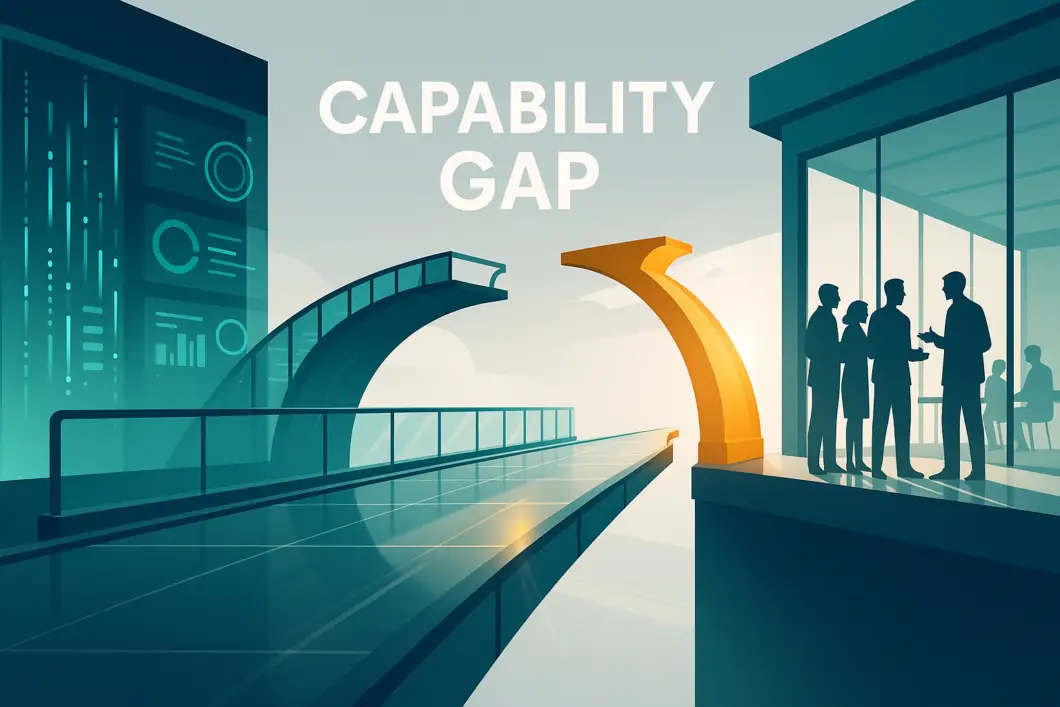
This is the invisible frontier of modern business—the capability gap that appears when systems outgrow people. It’s not that your team lacks intelligence or motivation; it’s that your organization has evolved faster than its human capability to keep up. In today’s fast-changing world, that’s more common than most leaders realize.
In this article, we’ll explore what this hidden gap looks like, why traditional training can’t fix it, and how experiential learning helps people catch up to their systems. We’ll also see how Practex supports organizations across the MENA region in transforming this challenge into a growth opportunity. The goal? To help you recognize the invisible gap before it costs you alignment, performance, and trust.
When Growth Outpaces Capability
Every organization dreams of scaling fast—but growth often brings complexity. Systems evolve to handle it, yet people rarely get the same structured opportunity to evolve alongside them. Here’s why that mismatch matters.
The Silent Strain of System Upgrades
When a company implements new systems—ERP tools, agile processes, or digital platforms—it’s often assumed that training sessions will suffice. But in practice, these upgrades don’t just change tools; they change how people make decisions, collaborate, and prioritize. Without behavioral adaptation, technology becomes a burden rather than an enabler.
This leads to resistance, errors, and underutilization. Here’s why that matters: people don’t resist change—they resist feeling incapable. The capability gap forms precisely there.
The Invisible Lag Between Strategy and Skill
Strategies can shift overnight, but human capability lags behind. Imagine a government agency adopting data-driven policy design. The systems can process real-time data, but decision-makers still rely on intuition. The result? Technology leads, people follow, and the organization moves unevenly.
Building on this, the real challenge isn’t just skill—it’s mindset agility and confidence in using new systems effectively.
Why Traditional Training Misses the Mark
Conventional training assumes knowledge equals readiness. Yet awareness doesn’t automatically translate into capability. A leader might understand agile principles but struggle to apply them under pressure. Real capability only emerges through practice, reflection, and feedback.
This is where experiential learning, as championed by Practex, becomes critical—it bridges knowing and doing by giving people a safe space to practice real decisions without real-world risk.
Understanding how growth creates invisible strain sets the stage for our next focus: identifying the subtle signs that your systems have already outpaced your people.
Spotting the Hidden Capability Gap
Most leaders don’t notice the gap until performance drops. But there are early warning signs that your systems are sprinting ahead of your people. Let’s uncover what those look like in practice.
Misalignment Between Data and Decisions
You’ve invested in analytics, yet decisions still rely on gut instinct. That’s not defiance—it’s discomfort. When teams don’t trust or understand the data, they revert to what feels safe. The gap isn’t in the system; it’s in confidence and comprehension.
In practice, this shows up as delayed decisions, inconsistent metrics, or endless meetings to validate what the data already shows.
Tool Adoption Without Behavior Change
New systems often promise efficiency. But if managers still micromanage or teams still silo information, the promised efficiency never arrives. Technology amplifies existing behaviors—it doesn’t correct them.
This leads to frustration and “shadow systems” where employees bypass official tools to get work done. Here’s where experiential learning, like the simulations Practex designs, helps teams experience collaboration breakdowns safely and rebuild better habits.
Capability Fatigue
In fast-transforming organizations, people face constant upskilling pressure. But without time to practice, learning becomes transactional. Employees collect certificates, not capability. The result? Fatigue disguised as disengagement.
Building on this, experiential approaches allow people to internalize learning, not just memorize it—turning fatigue into confidence.
Recognizing these signs early gives you a head start. But what makes this gap so persistent? The next section dives into the deeper forces that keep organizations trapped between progress and people.
Why the Capability Gap Persists
Even when leaders know the gap exists, it often widens. Why? Because most organizations address symptoms—training hours, certifications, or software proficiency—without tackling the underlying behavioral shift.
Speed Over Sustainability
Modern transformation agendas, like Vision 2030 in the MENA region, prioritize speed. But capability development takes time. When leaders push rapid system adoption without allowing for human adaptation, the result is fragile progress—quick wins followed by quiet regression.
This becomes even more critical when external pressures demand visible results faster than people can evolve internally.
The Myth of One-Size-Fits-All Learning
Traditional training assumes uniform learning needs. Yet capability gaps differ across functions and individuals. A finance leader might struggle with digital dashboards, while a project manager battles cross-functional communication. Treating everyone the same dilutes impact.
Practex’s experiential simulations counter this by tailoring scenarios to real organizational dynamics, ensuring learning feels relevant and personal.
Psychological Safety and Fear of Exposure
One hidden barrier is fear—fear of looking incompetent in new systems. Without psychological safety, employees hide their confusion, creating silent capability decay. Teams pretend alignment until results reveal the truth.
In practice, creating a safe space for mistakes—something Practex emphasizes—turns vulnerability into growth and collective learning.
Understanding why the gap persists prepares us to explore what actually bridges it: experiential, human-centered learning that matches the pace of change.
Bridging the Gap Through Experiential Learning
Bridging the capability gap requires moving beyond knowledge transfer to real behavior change. That’s where experiential learning comes in—it transforms understanding into capability through immersive practice.
Practice Before Performance
In sports or aviation, no one performs without practice. Yet in business, we expect flawless execution after a PowerPoint workshop. Experiential learning flips that script by letting people make real decisions in simulated environments before facing real consequences.
This leads to deeper retention and confidence. Practex’s simulations, for example, allow leaders to test strategies safely, reflect, and recalibrate—closing the knowing-doing gap.
Reflection as the Engine of Learning
Action without reflection is just activity. Experiential learning embeds structured reflection, helping teams connect outcomes to decisions. This transforms mistakes into insights and insights into new habits.
Building on this, reflection sessions in Practex programs often reveal hidden dynamics—like communication breakdowns or unclear accountability—that theory-based training misses.
Feedback That Fuels Growth
Feedback in simulations is immediate and specific. It helps participants understand the impact of their behavior in real time. Unlike end-of-course evaluations, this feedback loop accelerates capability growth.
In practice, this means participants don’t just learn what to do differently—they experience why it matters, embedding change at a behavioral level.
By combining practice, reflection, and feedback, experiential learning turns capability gaps into learning laboratories. But how can organizations embed this approach sustainably? That’s our next step.
Embedding Capability Building Into the Organization
To sustain capability growth, experiential learning can’t be a one-off event—it must be part of the organizational fabric. Let’s explore how to make that shift.
Make Learning Contextual
Generic case studies don’t drive change. When learning mirrors real challenges—like managing hybrid teams or navigating regulatory complexity—people engage more deeply. Practex designs contextual simulations that mirror each organization’s ecosystem, making learning feel directly relevant.
This leads to faster application and stronger retention because people see immediate value in what they’re practicing.
Integrate Learning With Strategy
Capability building should align with business goals, not sit beside them. When simulations mirror strategic priorities—such as digital transformation or customer-centricity—learning becomes a strategic accelerator.
In practice, this means every program contributes directly to outcomes leaders care about, bridging the gap between HR initiatives and business performance.
Measure Behavioral Outcomes, Not Attendance
Too often, L&D success is measured by participation rates. But real ROI lies in behavior change. Experiential programs allow clear tracking of how decisions, collaboration, and leadership behaviors shift over time.
Practex works with clients to design measurable indicators—so capability development becomes visible, not invisible.
Once capability building becomes embedded, the organization evolves in sync with its systems—reducing friction, boosting confidence, and building resilience. The next question is: what does this future-ready organization look like?
The Future of Capability in a System-Driven World
As technology continues to reshape work, the organizations that thrive will be those where human capability evolves at the same pace as systems. Here’s what that future looks like.
Adaptive Leadership as a Core Competency
Future leaders won’t just manage people; they’ll orchestrate systems, data, and human behavior simultaneously. Adaptive leadership—built through experiential practice—will be the differentiator between those who react and those who reinvent.
This becomes even more vital as organizations balance automation with empathy and analytics with judgment.
Continuous Learning Ecosystems
Learning will shift from periodic events to continuous experiences. Simulation-based practice, peer learning, and micro-reflection will become the new normal. Practex already supports organizations building these ecosystems, ensuring capability evolves in real time.
The result? A culture where learning isn’t a department—it’s a daily behavior.
Technology as a Partner, Not a Threat
As AI and automation expand, the human edge will be adaptability, creativity, and emotional intelligence. Experiential learning strengthens these precisely because it simulates uncertainty and requires human judgment.
Building on this, the most advanced systems will still need capable humans at the center—people confident enough to make sense of complexity.
That brings us full circle: when systems outgrow people, the solution isn’t slowing technology—it’s accelerating human capability through practice and reflection.
Moving Forward
The capability gap you can’t see is often the one that costs the most. When systems evolve faster than people, organizations lose alignment, agility, and trust. But the good news is that this gap isn’t inevitable—it’s bridgeable.
By embedding experiential learning—practice, reflection, and feedback—into your development strategy, you turn transformation into a human-centered journey. Practex helps organizations across Egypt, KSA, and the UAE do exactly that: create safe spaces for real decisions, strengthen leadership confidence, and align human capability with organizational ambition.
Ready to bridge your invisible capability gap? Connect with Practex to explore how simulation-based learning can help your teams move from theory to practice—and keep pace with the systems shaping your future.